Structural analysis is the dimensioning and verification of a structure by calculation. It demonstrates that a machine, steel structure or lifting accessory withstands the loads acting on it throughout its service life without permanent deformation, fracture, buckling or fatigue damage. The result is only as reliable as the input data: load cases, materials, joints and supports.
At Hefmec, we carry out structural analysis both as part of our own machine and equipment design and as a separate service – analytically by hand calculation and with FEM analysis. This article explains what structural analysis examines, how the calculation proceeds and how to choose between hand calculation and FEM.
What does structural analysis examine?
A structure can fail in several ways, and each failure mode is checked separately. Structural analysis typically examines the following:
- Static strength: whether the stress exceeds the yield strength of the material under the maximum load.
- Stability: whether a compressed member buckles or a thin plate buckles locally before the material yields.
- Fatigue: whether the structure withstands repeated loading, especially at welds and other stress concentrations.
- Stiffness: whether deflections and displacements remain small enough for the machine to function and keep its accuracy.
- Joints: whether welds, bolts and pins withstand the loads the structure transfers through them.
Strength is therefore not a single number. A structure can be generously oversized for static loads and still crack next to a weld after a few years of use if fatigue has not been assessed. In machine frames, stiffness often governs the design: the permissible deflection is reached long before the strength limit.
The calculated stress or force is compared with a permissible value, and the design standard defines the required safety margin. For steel structures, Eurocode 3 (EN 1993) applies partial safety factors to both loads and materials, and for lifting accessories the standard EN 13155 sets its own requirements. The result is often expressed as a utilisation ratio, i.e. how much of the structure’s capacity the load uses.
Where does structural analysis start?
Before calculating, we decide which question the calculation is to answer. Load cases describe the situations in which the structure is most heavily stressed: normal operation, overload, lifting, transport, installation and possible collision or fault situations. The following information is also needed:
- the magnitude, direction and position of the loads and their dynamic additions, such as accelerations, impacts and vibration
- how many times the load is repeated during the service life
- materials and their strength values
- the type of joints and the quality requirements for welds
- how the structure is supported and fastened
- the applicable standard or the customer’s own requirement.
Choosing the load cases is the most important step of the analysis, because a calculation can be flawless and still answer the wrong question. If, for example, a transport or lifting situation is missing, the structure may be dimensioned for operation but be damaged before it is even commissioned.
Static or dynamic loading?
In static design, the load is assumed to be constant or slowly changing, and the structure is checked against the maximum load. When the load varies and is repeated – machine movement, lifting and lowering, rotating parts or vibration – the structure can fatigue at stresses well below the yield strength. Fatigue resistance depends on the stress range, the number of load cycles and the shape of the structural detail. The weld toe is a typical starting point for a fatigue crack, which is why the fatigue design of steel structures (EN 1993-1-9) classifies welded details separately.
Impacts and rapid load changes are taken into account either with a dynamic factor or with a dynamic analysis. If rotating or vibrating equipment is attached to the structure, its natural frequencies are also checked so that the structure does not go into resonance.
Hand calculation or FEM – which is enough?
Both are structural analysis. The difference lies in how the behaviour of the structure is modelled.
| Hand calculation (analytical) | FEM analysis (finite element method) | |
|---|---|---|
| Suitable for | beams, members, shafts, bolts and welds; design formulas of standards | complex geometry, plate structures, stress concentrations, contacts, natural frequencies |
| Strength | fast, transparent and easy to check | shows the stress distribution across the whole structure and reveals critical areas |
| Limitation | requires simplifications; local stress concentrations rely on estimates | result depends on the mesh, boundary conditions and material model; requires interpretation |
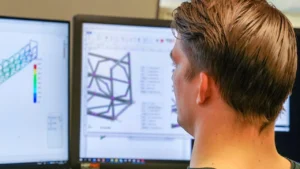
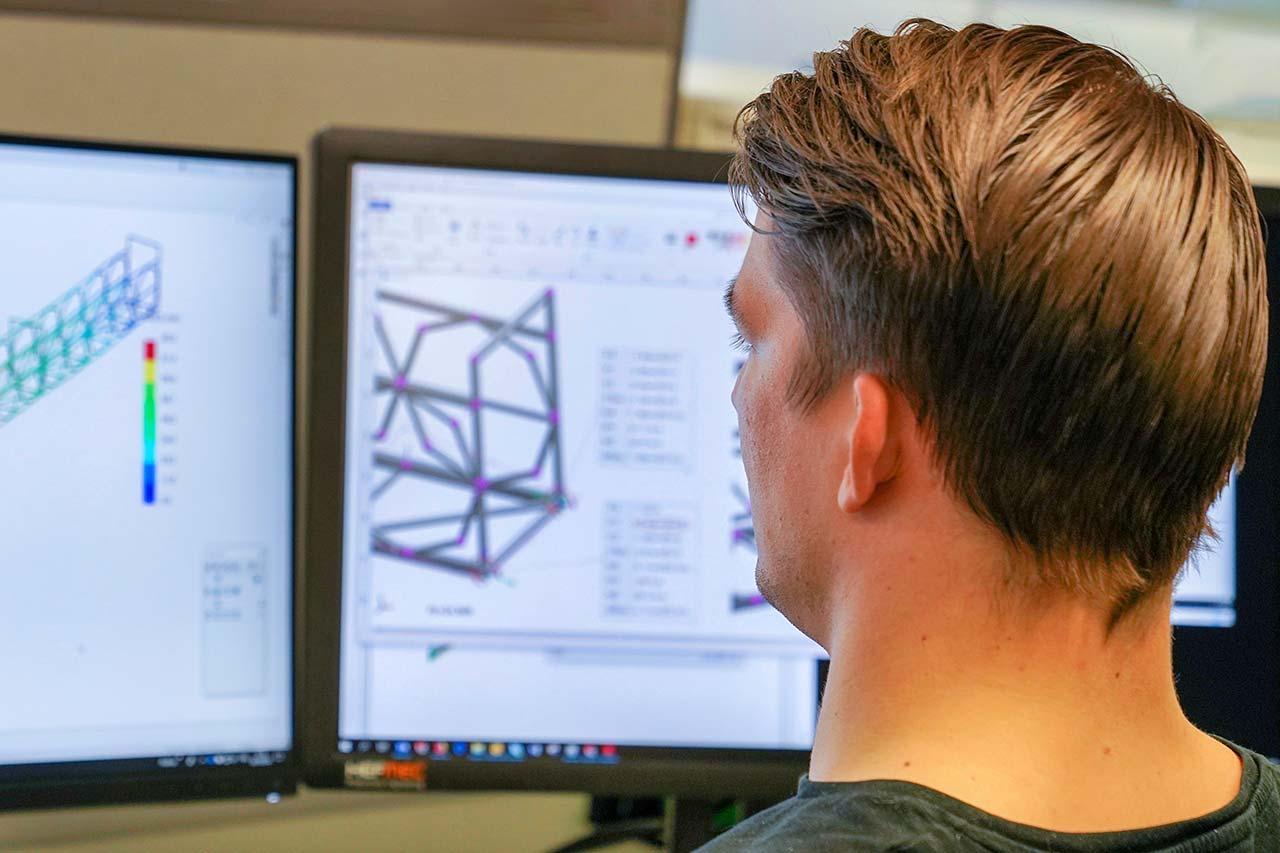
An FEM model is always an approximation. Overly stiff supports, a too coarse mesh or a sharp inner corner can produce a stress peak that does not exist in the real structure – or hide one that does. This is why an FEM result is not a finished answer without interpretation. We carry out FEM analyses with SolidWorks Simulation and ANSYS.
How are the results of structural analysis interpreted?
The colour plot of an FEM analysis shows where the stresses are highest, but a red area does not automatically mean a defect. Interpretation distinguishes whether a high stress is real or caused by the modelling, whether it is significant for the load-bearing capacity or only local, and which failure mode governs at that point. Local yielding may be acceptable for static loads, while the fatigue resistance of the same point may govern the design.
The results are compiled into a structural analysis report containing the input data, load cases, materials, methods and standards used, results and conclusions. The report also states the assumptions. They make it possible to check the calculation and to assess whether it is still valid if the structure or its use is changed later.
Example: can the machine frame carry an additional load?
A typical question is: will a welded steel frame hold if a 500 kg unit is added to the machine? The answer is not found by comparing the additional load with the original capacity of the frame, because that is rarely documented. The calculation clarifies:
- where and how the unit is fastened – the load often enters the frame through a few bolts or welds
- whether the load is stationary or moving, and whether it causes accelerations or vibration
- which profiles, welds and supports carry the load all the way to the foundation
- the current loading and condition of the frame.
The critical point is often the fastening point or the nearest weld, not the profile itself. Once the weak point has been identified, any reinforcement can be targeted there, and the whole frame does not need to be rebuilt.
Is structural analysis needed for CE marking?
The Machinery Directive 2006/42/EC and the Machinery Regulation (EU) 2023/1230, applicable from 20 January 2027, require that the parts of machinery and their linkages withstand the stresses to which they are subjected during use. The legislation does not prescribe a calculation method, but strength must be demonstrated, and the calculations and test results used to verify conformity belong in the technical documentation of the machine. In practice, the strength of load-bearing structures is demonstrated by structural analysis, testing or a combination of both.
For lifting accessories, the verification method is defined in the standard EN 13155: strength is demonstrated by structural analysis supplemented by a proof load test, or by testing alone. Read more in the articles CE marking of lifting accessories and proof load test for lifting accessories.
What are the consequences of inadequate structural analysis?
An undersized structure can crack, deform permanently or fail, and the repair is often made only during operation, when it is most expensive. An oversized structure, on the other hand, is heavier and more expensive to manufacture than necessary, and the extra mass can increase the load on other parts such as supports, drives or the hoist. The aim of structural analysis is a structure that is technically and economically correctly dimensioned: material is placed where it is needed.
Typical causes of inadequate analysis are:
- a load case is missing, for example lifting, transport or installation
- fatigue is not assessed even though the load is repeated
- the supports in the FEM model are stiffer than in reality, so the stresses are distributed too favourably
- the calculation assumes a weld quality that is not verified in manufacturing
- the structure or its use is changed, but the calculation is not updated.
Where do we use structural analysis?
Most of the projects we deliver include structural analysis. We calculate load-bearing steel structures, machine frames and lifting accessories, and prepare load securing calculations for transport. Our projects have included, for example, FEM analysis of steel structures supporting production equipment, shock analysis of valve racks, fatigue analysis of a special lifting accessory for a frequency converter and structural analysis of the brackets in a wind turbine service area. We also review calculations prepared by others, such as the structural analysis report of transport equipment.
Because we also design and manufacture ourselves, we take into account in the calculation how the structure is welded, assembled and inspected. Structural analysis is part of the whole design process, not a separate check at its end – read more in the article What is machine design, and how does a project progress?
Do you have any questions?
We are happy to help you find out what kind of analysis your structure needs. You can find more information on our structural analysis service page, or contact our Service Manager directly:
Aki Jalonen, Service Manager, Structural Analysis, tel. +358 50 492 7579, aki.jalonen@hefmec.com