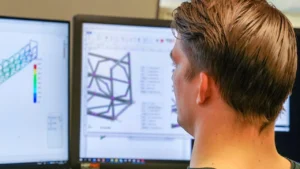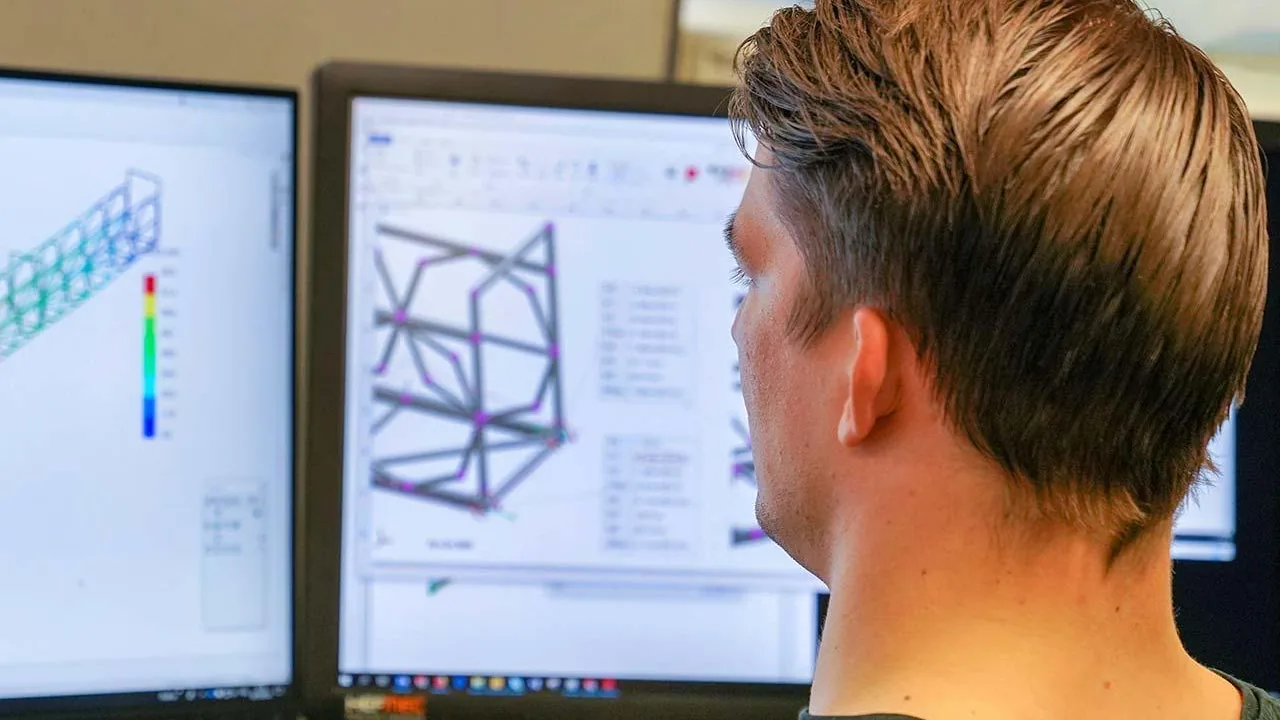
FEM calculation (Finite Element Method) is a numerical method for determining how a structure is stressed, deflects and vibrates under load. The model of the structure is divided into thousands of small elements, and the software solves their displacements and stresses. FEM calculation is needed when the geometry, loading or joints of a structure are so complex that hand calculation cannot give a reliable picture of how the stresses are distributed.
At Hefmec, we carry out FEM analyses for steel structures, machine frames and lifting accessories as part of our structural analysis service. In this article, we explain how FEM calculation proceeds, what it can determine and what the reliability of the result depends on.
What does FEM stand for?
FEM stands for Finite Element Method. FEM calculation, FEM analysis and FEA (Finite Element Analysis) all refer to the same thing. When FEM calculation is used to dimension a structure and verify its strength, it is part of structural analysis.
The idea behind the method is simple. A complex part cannot be solved with a single formula, but the behaviour of a small element with a simple shape is known. When the elements are connected to each other at nodes, the software builds a system of equations for the whole structure and solves it. The finer the element mesh, the more accurately the model represents the real geometry – and the heavier the calculation becomes.
How does FEM calculation work?
FEM calculation follows the same steps regardless of the software:
- Geometry: the 3D model is simplified for the calculation. Fillets, small holes and other details that do not affect the strength of the area being examined are removed, and thin sheet metal structures can be modelled with shell elements.
- Element mesh: the model is divided into elements. The mesh is refined where stresses change rapidly, such as at corners, hole edges and joints.
- Materials: each part is given a material model. For steel, this usually means the modulus of elasticity and Poisson’s ratio and, if needed, the yield strength and strain hardening.
- Boundary conditions and loads: we define how the structure is supported and fastened and which load cases are calculated. This step has the greatest effect on the result.
- Solution: the software calculates the displacements of the nodes and, from them, the strains and stresses.
- Checking and interpretation: the plausibility of the model is checked, and the results are compared with permissible values before conclusions are drawn.
The software performs meshing and solving almost automatically. The engineer’s work lies in the other steps: what to model, how the structure is supported and loaded, and what the results mean.
What can FEM analysis calculate?
| Analysis | What it determines | Typical use |
|---|---|---|
| Linear static | stresses and displacements while the material remains elastic | basic dimensioning of steel structures, machine frames and lifting accessories |
| Non-linear | yielding, large displacements and contacts where surfaces touch, separate or slide | bolted and pinned joints, grippers, acceptability of local yielding |
| Buckling | the load at which a compressed member or thin plate loses its stability | slender columns and supports, sheet metal structures, booms |
| Natural frequencies | the natural frequencies and mode shapes of the structure | frames and racks carrying rotating or vibrating equipment |
| Fatigue | whether the structure withstands repeated loading throughout its service life | welded structures, lifting accessories, moving machine parts |
| Dynamic and shock | the effect of an impact or a rapid load change | impact loads, transport, shock analysis |
The type of analysis is chosen according to the failure mode that governs the structure. Linear static analysis is the most common, but it says nothing about buckling or fatigue. If the structure is slender or the load is repeated, a static check alone can give too favourable a picture of its safety.
When is FEM calculation needed?
FEM is not always the most accurate or the best option. Beams, members, shafts, bolts and welds are often calculated faster and more transparently by hand using the design formulas of standards. FEM calculation is needed when
- the geometry is complex, for example a cast part or a plate structure for which there is no ready-made design formula
- the structure contains stress concentrations, such as openings, shoulders and discontinuities in stiffness
- the load is distributed through several paths in the structure, making it difficult to assess by hand
- information is needed on the stiffness, deflections or natural frequencies of the whole structure
- the structure is to be made lighter and the material placed where the stresses are.
In practice, the methods complement each other: the behaviour of the whole structure is determined with an FEM model, and individual joints are dimensioned by hand. We discuss the differences between hand calculation and FEM in more detail in the article What is structural analysis?
What does the reliability of an FEM result depend on?
FEM software always gives a result, even when the model is wrong. The reliability of the result therefore depends on the model, not on the software. The most common sources of error are the following:
- Boundary conditions: a completely rigid fixing is rarely realistic. If the support in the model is stiffer than in reality, the load is distributed too favourably. If it is more flexible, the stresses can shift to the wrong place.
- Element mesh: a mesh that is too coarse does not give a true picture of the stresses. At critical locations, the mesh is refined to obtain more realistic results.
- Singularities: a sharp inner corner, a point load or a point support produces a stress that grows without limit as the mesh is refined. It is a property of the model, not a real stress, and it is not compared directly with the yield strength.
- Welds: the stress at the weld toe depends on how the weld is modelled. In fatigue assessment, methods defined in standards, such as the nominal stress or the structural (hot spot) stress, are therefore used, because using the peak values of the model gives an overly conservative result.
- Material model: a linear model assumes the material is elastic even above the yield strength. If the calculated stress exceeds the yield strength, the figure from a linear analysis does not represent the actual stress.
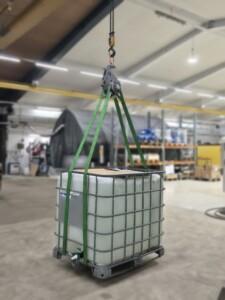
The plausibility of the model is checked before conclusions are drawn: do the support reactions match the loads, are the displacements of the right magnitude, and does a simplified hand calculation agree with the FEM result? For lifting accessories, the calculation is supplemented by a proof load test, which verifies the strength of the structure physically.
What is needed for an FEM calculation?
The calculation is faster and the result more reliable when the input data is ready. The customer usually needs to provide
- a 3D model or drawings, for example in STEP format
- the loads and their positions, and whether the load is repeated or causes impacts
- the method of support and fastening
- the materials and the quality requirements for welds
- the applicable standard or own requirement, for example the permissible deflection.
If not all the information is available, the load cases and assumptions are agreed before the calculation and recorded in the structural analysis report. The customer then sees what the result is based on, and the calculation can be updated if the structure or its use changes later.
How do we carry out FEM calculation at Hefmec?
We carry out FEM analyses with SolidWorks Simulation and ANSYS. Most of the projects we deliver include structural analysis, and our projects have included, for example,
- FEM calculation of load-bearing steel structures
- FEM calculation of steel structures supporting production equipment
- shock analysis of valve racks
- FEM calculation of a mobile access system
- fatigue analysis of a special lifting accessory for a frequency converter.
As we also design and manufacture ourselves, we take into account in the calculation how the structure will be welded, assembled and inspected. When an FEM analysis reveals a critical point, reinforcement can be targeted there, and the whole structure does not need to be oversized. Structural analysis is part of the entire design process – read more in the article What is machine design, and how does a project progress?
Do you have any questions?
We are happy to tell you whether your structure needs an FEM analysis or whether hand calculation is enough. You can find more information on our structural analysis service page, or contact our service manager directly:
Aki Jalonen, Service Manager, Structural Analysis, tel. +358 50 492 7579, aki.jalonen@hefmec.com