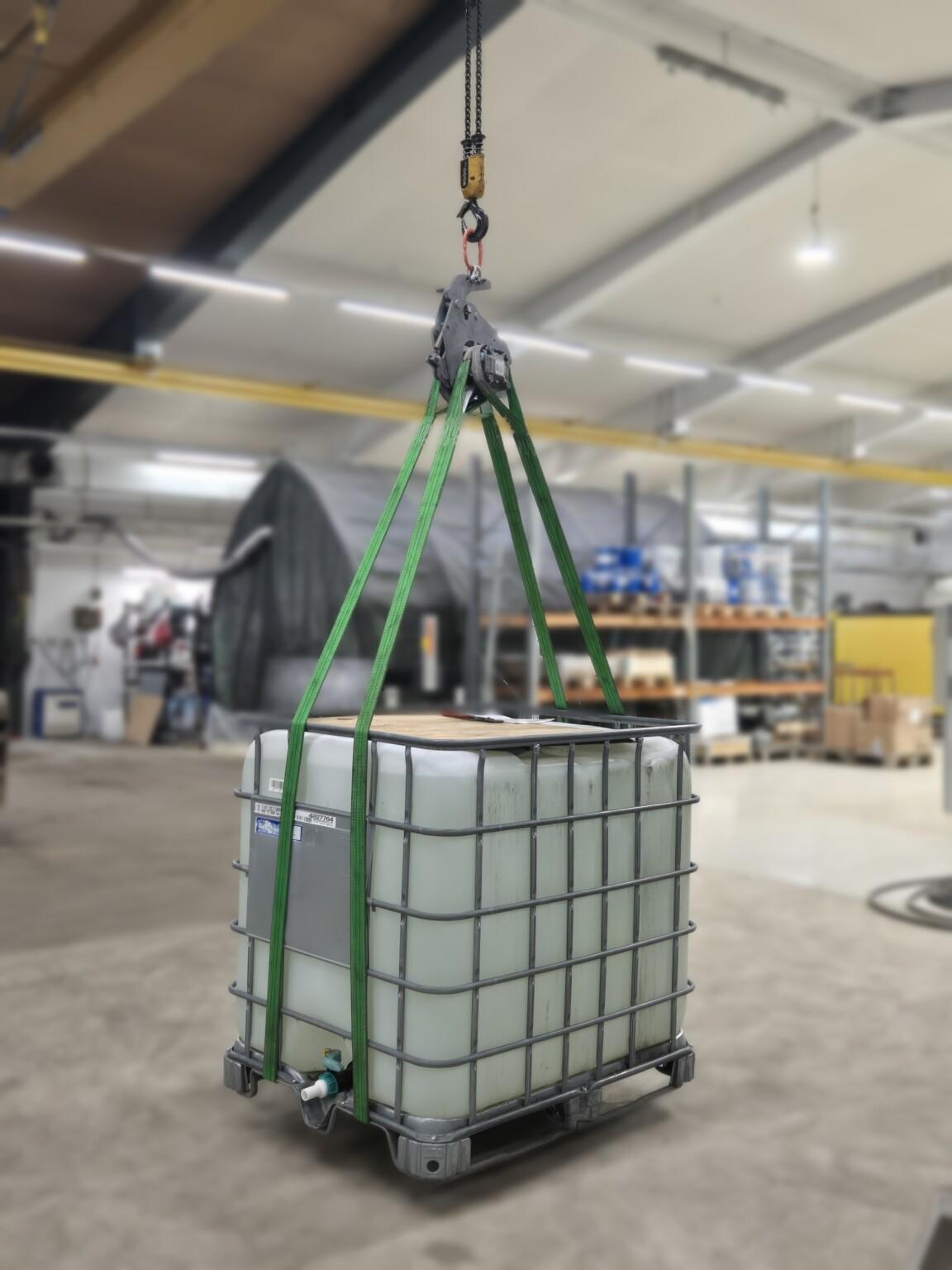
A proof load test for a lifting accessory means that the accessory is loaded with a load greater than its working load limit (WLL) and checked to make sure that the structure does not deform permanently or fail. The updated, harmonised version of the standard for non-fixed load lifting attachments, SFS-EN 13155:2020+A1:2025, changes what the proof load test is used for: it either verifies the result of the structural analysis or is itself the proof of strength, in which case the loads are 2 × WLL and 3 × WLL. The reference to the old version, EN 13155:2003+A2:2009, remains valid until 19 January 2027.
What changed in EN 13155, and when?
EN 13155 applies to non-fixed load lifting attachments attached to a crane hook, such as lifting beams, plate clamps, vacuum lifters and various grippers. The 2020 edition, EN 13155:2020, was published in 2020, but it was not harmonised under the Machinery Directive as such. Only Amendment A1 in 2025 corrected the errors in the verification methods of that edition, after which the standard was accepted as harmonised.
| Date | What happened |
|---|---|
| 2009 | EN 13155:2003+A2:2009 was harmonised under the Machinery Directive 2006/42/EC |
| December 2020 | The EN 13155:2020 edition was published, but it was not published in the Official Journal of the EU |
| June 2025 | Amendment A1 was published, and SFS published the consolidated version SFS-EN 13155:2020+A1:2025 (27 June 2025, in English) |
| 13 March 2026 | EN 13155:2020+A1:2025 was published as a harmonised standard under the Machinery Directive (Implementing Decision (EU) 2026/546) |
| March 2026 | Corrigendum AC:2026 to the standard was published |
| 7 September 2026 | The reference to the harmonised standard was updated to the corrected version EN 13155:2020+A1:2025/AC:2026 (Implementing Decision (EU) 2026/2015) |
| 20 January 2027 | The reference to the old EN 13155:2003+A2:2009 ends, and the EU Machinery Regulation (EU) 2023/1230 applies from this date |
Why is the proof load test the most important change in the update?
According to the foreword of the standard, the updated version contains two separate ways to verify the strength of a lifting accessory. Both use a proof load test, but for different purposes.
| Calculation and proof load test | Testing only | |
|---|---|---|
| How strength is demonstrated | By structural analysis in accordance with EN 13001-1 and EN 13001-2 | By proof load testing, without calculation |
| Role of the proof load test | Verifies that the calculated strength is correct | Is itself the proof of strength |
| Proof load | 1.5 × WLL when WLL ≤ 20 t · (1.56 − WLL/350) × WLL when 20 t < WLL < 160 t · 1.1 × WLL when WLL ≥ 160 t | Type: 2 × WLL without permanent deformation and 3 × WLL without releasing the load. Individual item: 2 × WLL |
| Special considerations | Lower working coefficients are permitted in certain technically justified cases | An item tested at 3 × WLL may be used after the test if it shows no permanent deformation or defects |
In practice, this means that structural analysis alone is not enough. When a designer dimensions a lifting accessory by calculation, the result of the calculation is verified by a proof load test.
In the 2020 edition, the standard moved to dimensioning in accordance with the crane standards EN 13001-1 and EN 13001-2, and the number of design load cycles was reduced from 20,000 to 16,000. These changes remain in force in the harmonised version.
What does the change mean for the manufacturer of a lifting accessory?
The change applies to anyone who places a lifting accessory on the market or puts one into service in their own production. A company that manufactures a lifting accessory for its own use is also a manufacturer and is responsible for the CE marking. This is explained in more detail in the article CE marking of lifting accessories.
The manufacturer should choose the verification method already at the design stage, as it affects both the structure and the manufacturing costs:
- Individually manufactured lifting accessory: calculation and proof load test is usually the natural route. Every individually manufactured accessory is proof load tested, and on the calculation route the accessory does not break in the test.
- Series-produced lifting accessory: the choice depends on the case. The cost of calculation per manufactured item decreases as the series size grows, and optimising the structure and mass is easier by calculation than by testing. On the other hand, testing alone can result in a lighter accessory, because calculation includes conservative assumptions and partial safety factors – for example, the actual yield strength of S355 steel is often clearly higher than the guaranteed 355 MPa used in calculation. In a series, a type test is carried out on at least one item, and sampling is defined for the other items.
- Welded structures: the designer takes the weld quality level into account in the calculation, and the manufacturer uses an qualified welding procedure specification (WPS). Read more in the article WPS and welding procedure specifications for lifting accessories.
The proof load test results belong in the technical documentation of the lifting accessory, alongside the structural analysis report, the risk assessment and the instructions for use.
Does the change apply to lifting accessories already in use?
Not directly. The standard applies to the design and manufacture of a lifting accessory before it is placed on the market. A lifting accessory manufactured and CE marked in accordance with the old standard does not become non-compliant because of the update. Inspections of lifting accessories in use are governed by the regulations on use – in Finland, by the Government Decree on the safe use and inspection of work equipment (403/2008).
If the intended use or the working load limit of an existing lifting accessory is changed, the manufacturer reassesses the accessory in accordance with the current version of the standard.
How is the EU Machinery Regulation related to the update?
The EU Machinery Regulation (EU) 2023/1230 applies from 20 January 2027 and replaces the Machinery Directive. From the same date, presumption of conformity can no longer be based on the old version EN 13155:2003+A2:2009. References to harmonised standards under the Machinery Regulation are published in the Official Journal of the EU in a separate implementing decision. An up-to-date list is available on the European Commission’s harmonised standards page.
How Hefmec works
We design and manufacture lifting accessories for the customer’s workpiece and lifting operation, such as a lifting beam or a gripper. The same package includes structural analysis and proof load test planning as well as the technical documentation required for CE marking. We also help you choose which verification method suits the application.
Frequently asked questions
Can a lifting accessory be designed according to the old version EN 13155:2003+A2:2009?
The reference to the old version is valid until 19 January 2027, so new designs are made according to the updated version.
Is SFS-EN 13155:2020+A1:2025 available in Finnish?
SFS published the consolidated version in English. A Finnish translation of the 2020 edition has been published without Amendment A1. The availability of language versions can be checked in the SFS online shop.
Does every lifting accessory need a proof load test?
An individually manufactured lifting accessory is always proof load tested. For series-produced accessories, not every item needs to be proof load tested: a type test is carried out on at least one item in the production series, and the sampling for individual verification of the other items is defined according to the series size and manufacturing methods. This applies to both the calculation route and the testing route.
Still have questions?
For questions about the structural analysis and proof load testing of lifting accessories, you can contact Service Manager Aki Jalonen directly at +358 50 492 7579. Read more: structural analysis and proof load test planning.