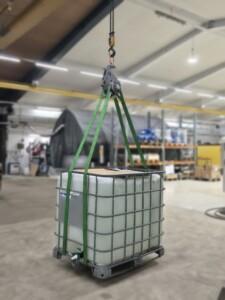
The CE marking of lifting accessories requires that they meet the safety requirements set by the European Union (EU). The CE marking is not granted by an authority; it is the responsibility of the manufacturer or importer. Manufacturers of lifting accessories must comply with the EU Machinery Directive 2006/42/EC – from 20 January 2027 the EU Machinery Regulation (EU) 2023/1230 – and the applicable standards. The key standard for lifting accessories is EN 13155 (Non-fixed load lifting attachments).
General requirements for the CE marking of lifting accessories
- Essential safety requirements: A lifting accessory must meet the essential requirements for the safety of machinery. These requirements relate, for example, to design, manufacture, instructions for use, markings, safety measures and risk reduction.
- Risk assessment: The manufacturer of a lifting accessory must carry out a risk assessment that identifies potential hazardous situations and evaluates their risks. Risk control measures are implemented during design, manufacture and use.
- Instructions for use: The lifting accessory must be supplied with clear and understandable instructions for use, including safety instructions, operating limitations and maintenance instructions.
- Markings: The lifting accessory must bear the CE marking and other necessary markings, such as the name and address of the manufacturer, the serial number and the working load limit (WLL).
- Declaration of conformity: The manufacturer of the lifting accessory must declare that it has been designed and manufactured in accordance with the applicable legislation, standards and technical requirements.
What do the Machinery Regulation and the EN 13155 update change?
The EU Machinery Regulation (EU) 2023/1230 applies from 20 January 2027 and replaces the Machinery Directive. The principle of CE marking remains the same: the manufacturer assesses the risks, compiles the technical documentation and the declaration of conformity, and affixes the CE marking to the lifting accessory.
The version EN 13155:2020+A1:2025 of the standard for non-fixed load lifting attachments was harmonised under the Machinery Directive on 13 March 2026. Under it, the strength of a lifting accessory is verified either by structural analysis supplemented by a proof load test, or by testing alone. The reference to the previous version EN 13155:2003+A2:2009 is valid until 19 January 2027. The changes are explained in more detail in our article proof load testing and the EN 13155 update.
Lifting accessories that already carry the CE marking do not become non-compliant because of the update. New designs follow the updated version.
What is the difference between a lifting accessory and a special lifting accessory?
Lifting accessories are common and widely used lifting devices. Typical lifting accessories include shackles, lifting chains, lifting slings and various bolt-on lifting points.
Special lifting accessories are lifting devices designed specifically for special situations or particular lifting tasks. Examples of special lifting accessories include lifting frames, grippers, scissor lifting clamps and lifting beams with custom-designed lifting points. You can find more examples on our lifting accessories page.
The CE marking of special lifting accessories is subject to the same requirements as that of general lifting accessories, but the risk assessment and dimensioning must also take into account the special features of the accessory and the risks arising from them.
Design and CE documentation of a special lifting accessory
A design project for a special lifting accessory typically involves getting to know the item to be lifted and the requirements, developing the lifting method, modelling the lifting accessory and performing structural analyses. Under EN 13155, the result of the structural analysis is verified by a proof load test, or the strength is demonstrated by testing alone.
The technical documentation of a CE-marked special lifting accessory includes:
- a general description of the lifting accessory,
- technical drawings,
- component data,
- structural analysis report,
- proof load test results,
- risk assessment,
- instructions for use,
- declaration of conformity.
The author of the documentation is responsible for ensuring that the technical documentation meets the requirements of the applicable legislation and standards. If you order only the design and CE documentation of a lifting accessory, the manufacturer of the accessory is responsible for ensuring that it is manufactured in accordance with the technical documentation.
Manufacture of special lifting accessories
The manufacturer, or the party having the accessory manufactured, is responsible for its conformity and affixes its own CE marking to it as proof of this. When we manufacture and deliver a lifting accessory, we are responsible for ensuring that it is manufactured in accordance with the technical documentation, and we deliver it with the CE marking. In welded lifting accessories, manufacturing quality is ensured with a qualified welding procedure specification (WPS) – read more: WPS in welding and lifting accessories.
CE documentation of an existing special lifting accessory
A documentation project for a special lifting accessory typically involves getting to know the item to be lifted and the requirements, modelling the lifting accessory and performing structural analyses so that the appropriate CE documentation can be prepared. Under EN 13155, the result of the structural analysis is verified by a proof load test, or the strength is demonstrated by testing alone.
Typically, new CE documentation is prepared for a lifting accessory when its intended use is to be changed or its working load limit (WLL) is to be increased. In these cases, too, the author of the documentation is responsible for ensuring that the new technical documentation meets the requirements of the legislation and standards in force, while the manufacturer or the party having the accessory manufactured is responsible for its conformity and affixes its own CE marking to it. How the load capacity is determined is explained in load capacity of lifting accessories, and the inspection of lifting accessories in use in inspection of lifting accessories.
Do you have any questions?
We design and manufacture special lifting accessories for the customer’s workpiece and lifting operation and deliver them with the CE marking. Read more: Tool Service.
For any questions regarding CE marking, please contact Petja Lindström directly at +358 40 740 4771.