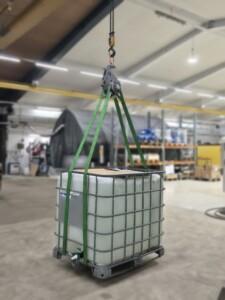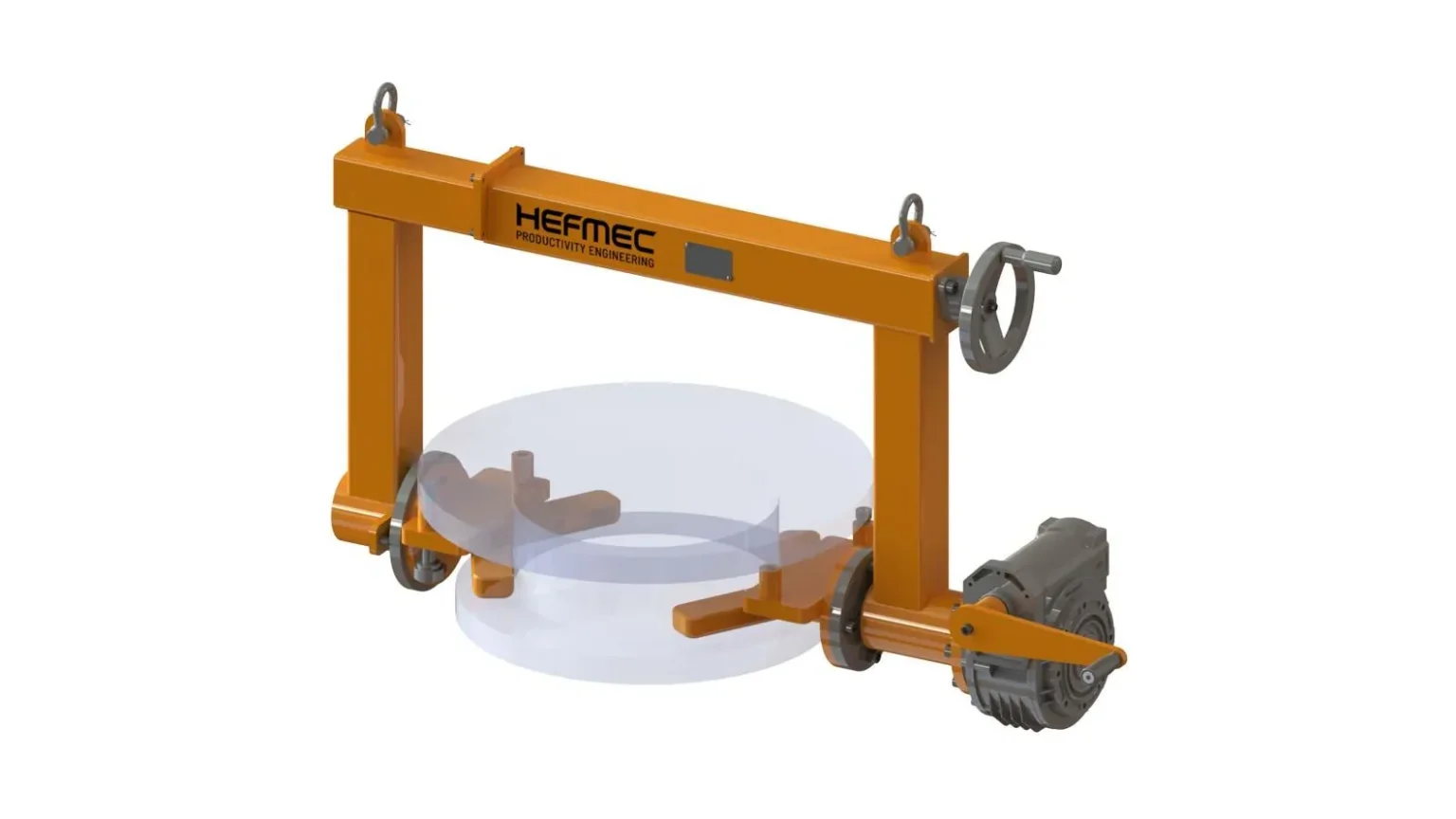
Lifting accessories are devices placed between the lifting device, such as a crane or hoist, and the load being lifted. They hold the load, keep it under control during the lift and, where needed, allow it to be turned or moved. A correctly chosen lifting accessory makes a lift safer, faster and repeatable.
At Hefmec, we design and manufacture lifting accessories for the customer’s workpiece and lifting operation and deliver them CE marked. In this article, we explain what lifting accessories include, what types there are, what is required of them and how to choose the right one.
What is a lifting accessory?
According to the definition in the Machinery Directive 2006/42/EC, a lifting accessory is a component or equipment not attached to the lifting machinery that allows a load to be held. It is placed between the machinery and the load or on the load itself, and it is placed on the market separately. Under the definition, slings and their components are also regarded as lifting accessories. The same definition continues in the Machinery Regulation (EU) 2023/1230, which applies from 20 January 2027.
In practice, lifting accessories fall into two groups:
- slings, chains, wire ropes and their components, which are usually standard products with their own standards
- non-fixed load lifting attachments, such as lifting beams, grippers and lifting frames, which are covered by the standard EN 13155.
A lifting device is a different thing: a crane, hoist or gantry crane produces the lifting movement, and the lifting accessory connects it to the load. The difference also shows in the requirements and the warranty, as a lifting accessory is a product in its own right with its own CE marking and inspections.
What types of lifting accessories are there?
The type of lifting accessory is chosen according to how the workpiece can be gripped and what needs to be done during the lift. Typical industrial lifting accessories include:
- Lifting beams and spreader beams: for lifting long workpieces or workpieces with several attachment points. In a lifting beam, the beam is in bending; in a spreader beam, it is in compression.
- Scissor grippers and scissor lifting clamps: grip the workpiece using the weight of the load itself, for example on flanges or edges.
- Collar grippers: for lifting and turning round workpieces, such as barrels and cylinders.
- Frame grippers and lifting frames: when the load needs to be supported at several points or the workpiece tends to deflect.
- Pneumatic grippers: for lifting plates and flat surfaces with vacuum.
See the full range on our lifting accessories page.
What are lifting accessories used for?
Lifting accessories are used wherever heavy, awkwardly shaped or delicate workpieces are lifted, turned or moved: in machine shops, on assembly lines, in service and maintenance work, in the energy industry and in cleanrooms. The benefit comes from three things:
- Safety: the load stays under control, and nobody has to guide it by hand.
- Ergonomics: turning and positioning are done with the device, not by muscle power.
- Consistency and efficiency: the same lift succeeds in the same way every time, and workpieces are damaged less often.
For example, for a customer in the engineering industry, we developed a lifting accessory for a spherical product that had to be lifted and turned at different stages of production. All stages are now carried out with the same device. In the nuclear industry, a lifting accessory we designed replaced three separate devices with one in the servicing of large shafts, and the work also became safer in terms of radiation.
What are the requirements for lifting accessories?
A lifting accessory must withstand the loads acting on it with safety factors, it must be marked and CE marked, and its condition must be inspected regularly. The key requirements are:
- CE marking and conformity under the Machinery Directive and, from 20 January 2027, the Machinery Regulation. Read more in the article CE marking of lifting accessories.
- Dimensioning and verification of the load capacity according to EN 13155: How is the load capacity of a lifting accessory determined and proof load testing of lifting accessories.
- Markings, such as the working load limit (WLL), manufacturer and year of manufacture: Markings and color codes on lifting accessories.
- Commissioning inspection and periodic inspections: What does the inspection of lifting accessories require.
How do you choose the right lifting accessory?
The choice starts from the workpiece and the lifting operation, not from a product catalogue. Before a device is chosen or designed, the following are determined:
- the mass, dimensions and centre of gravity of the workpiece – an eccentric centre of gravity tilts the load during the lift
- where the workpiece can be gripped without damaging its surfaces or structure
- whether the workpiece needs to be turned, positioned or moved during the lift
- the capacity and lifting height of the lifting device – the mass and height of the lifting accessory itself reduce both
- how often the lift is repeated, as repeated use also requires dimensioning for fatigue
- the operating environment, such as a cleanroom, outdoor use or high temperature.
Once this information is known, it can be assessed whether a standard product is suitable or whether a device designed for the workpiece is needed. A wrongly chosen device usually only becomes apparent in use: the load tilts, the gripper leaves marks or the lifting height is not sufficient.
Standard product or custom lifting accessory?
A standard product is sufficient when the workpiece is conventional and the lifting method simple, for example a sling lift from clear attachment points. A custom lifting accessory is worthwhile when
- the workpiece is awkwardly shaped, the centre of gravity is eccentric or the surfaces are delicate
- the lift also involves turning or positioning
- the same lift is repeated often, so a faster and safer lift pays for itself
- one device can replace several existing ones.
In a custom device, gripping, turning and dimensioning are designed specifically for the workpiece and the lifting device in question.
How are lifting accessories used safely?
Safe use is based on the device being the right one, in good condition and used according to the manufacturer’s instructions. In practice, this means the following:
- The user knows the device’s instructions for use and has been trained to use it.
- The working load limit (WLL) is not exceeded, and the device is not used for any purpose other than the one it was designed for.
- The device is visually checked before use: markings, deformation, cracks, wear and locking devices.
- A defective or unmarked device is taken out of use.
- The device is stored so that it is not damaged or corroded, and periodic inspections are carried out on time.
How do we design and manufacture lifting accessories?
We have delivered more than 1000 lifting accessory projects. The design starts from the workpiece and the lifting operation, and we dimension the device with structural analysis. As we also manufacture the devices ourselves, we take into account in the design how the structure will be welded, assembled and inspected. The finished device is proof load tested and delivered CE marked with its instructions for use.
We give the Hefmec Lifelong Guarantee for the CE-marked lifting accessories manufactured by Hefmec.
Do you have any questions?
We are happy to tell you what kind of lifting accessory suits your workpiece and lifting operation. Read more about our tool service or contact our product manager directly:
Juho Seppälä, Product Manager, Lifting Accessories, tel. +358 50 525 7504, juho.seppala@hefmec.com