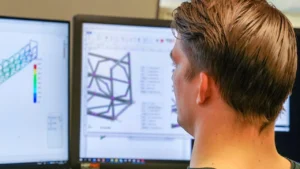
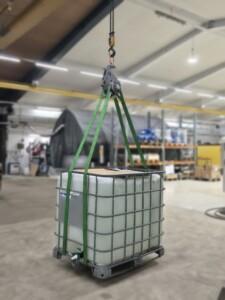
Mechanical design is the design of the mechanical structures of machines, equipment and their parts, from the user’s needs and requirements all the way to manufacturing and assembly drawings. It is an umbrella term that covers machine design, equipment design and machine element design. A mechanical designer balances function, strength, safety, manufacturability and cost so that the equipment can be manufactured and commissioned without surprises.
At Hefmec, we provide mechanical design for production equipment, lifting accessories, special machines, steel structures and our customers’ product development. In this article, we explain what mechanical design covers in practice, what a designer does and when it makes sense to buy design work from outside the company.
What does mechanical design cover?
Mechanical design is often divided according to what is being designed. In everyday language the terms overlap, but the distinction helps define what kind of expertise a project needs.
| Term | What is designed | Examples from our projects |
|---|---|---|
| Mechanical design | Umbrella term for all design of mechanical structures | – |
| Machine design | Machines with moving parts, actuators and controls | Valve pressure test rig, special tools for a vehicle part assembly cell |
| Equipment design | Production equipment and fixtures | Welding jig for vehicle battery sheet metal parts, format part trolley for cleanrooms |
| Machine element design | Individual parts and their joints | Grippers for a robot arm handling vehicle parts |
| Structural design | Load-bearing steel and aluminium structures | Steel structures supporting production equipment, brackets for a wind turbine service space |
A single project often includes several of these. A special machine needs machine design, its frame needs structural analysis and the steel structure that supports it needs structural design. We describe the phases of machine design in more detail in the article What is machine design, and how does a project progress?
What does a mechanical designer do?
A mechanical designer’s work starts before the CAD model. The designer first finds out what the equipment must do, in what environment and under what loads, and only then what it looks like. Typical tasks include
- interpreting and refining the requirements together with the customer and the equipment’s users
- developing and comparing concept alternatives
- 3D modelling and building assemblies
- dimensioning and, where needed, structural analysis
- manufacturing and assembly drawings, parts lists and tolerances
- selecting standard components and actuators
- supporting manufacturing, assembly and commissioning
- preparing technical documentation, for example for CE marking.
A good mechanical designer does not optimise one property at the expense of the others. A lighter structure may require a more expensive material or more difficult welding, and a tighter tolerance may improve function but raise the cost of machining. The designer’s task is to identify these conflicts and resolve them sensibly in view of what the equipment is used for.
How does a mechanical design project progress?
A project typically progresses in phases: requirements specification, concept design, detail design, dimensioning and verification, manufacturing documentation, and support for manufacturing and commissioning. The order of the phases matters more than their names. When the requirements and the concept are locked before detail design, changes are made at a stage where they are still quick and inexpensive.
We went through the phases from the perspective of machine design in the article What is machine design, and how does a project progress? The same progression applies to equipment design and structural design.
What do mechanical design decisions affect?
The choices made at the design stage determine much of what the equipment costs and how it performs throughout its service life.
- Manufacturability: if the welding sequence, access to machined surfaces or the assembly sequence is considered only at the drawing stage, the structure has to be changed when changes are already slow and expensive. That is why manufacturing should be involved already at the concept stage.
- Cost: material, number of parts, tolerances and the use of standard components determine the manufacturing cost. A tolerance that is too tight raises the price without any functional benefit, while one that is too loose can cause assembly or functional problems.
- Safety: guards, movement areas and operating logic affect the basic structure of a machine. When the risk assessment is carried out during design rather than on a finished structure, the safety solutions are part of the structure instead of being added afterwards.
- Maintainability and life cycle: if replacing a wearing part requires dismantling other parts of the structure, every maintenance shutdown is longer for the entire service life of the equipment.
What tools are used in mechanical design?
For 3D design, we use SolidWorks, Creo, Siemens NX, CATIA and Inventor, depending on the customer’s environment. When we design with the same software as the customer’s own product development, models and drawings transfer to the customer’s system without conversions.
Dimensioning is supported by hand calculation and FEM calculation. Hand calculation is often sufficient for simple structures, whereas in complex geometry and joints an FEM analysis shows how the stresses are distributed. We explain the role of structural analysis in the articles What is structural analysis? and What is FEM calculation and when is it needed?
A tool does not make a design good, however. A CAD model can be geometrically flawless and still difficult to manufacture, and an FEM result is only as reliable as its loads and boundary conditions.
What are typical mistakes in mechanical design?
Many design errors do not arise in calculation but in decisions that are made too early or too late. Typical ones are
- detail design starts before the requirements have been locked
- the first working idea is finalised without comparing it with other concepts
- manufacturing and assembly are involved only at the drawing stage
- tolerances are copied from earlier drawings without a functional reason
- no space is reserved for maintenance and installation, making the equipment difficult to install and service.
When should mechanical design be outsourced?
Outsourcing makes sense when
- your own design capacity is not enough for the project schedule
- the project requires expertise that your own team does not have, such as structural analysis or CE documentation
- the need is a one-off, and hiring your own designer is not justified
- you want design and manufacturing to be the responsibility of the same supplier.
Outsourced design works best when the customer is involved in the requirements specification and the choice of concept. After that, detail design can be left to the designer. As we also design and manufacture ourselves, we take manufacturability into account already at the design stage.
For example, we have produced 3D models and manufacturing drawings from sketches for Marioff since 2017. In a pre-design project for Valmet Automotive, we designed the welding processes for a golf cart frame and then the welding jigs in close cooperation with product design, which made the product easy to manufacture.
Do you have any questions?
We are happy to discuss how mechanical design could support your project. You can find more information on our mechanical design service page, or contact our service manager directly:
Mika Julin, Service Manager, Project and Expert Services, tel. +358 40 708 4567, mika.julin@hefmec.com