Industrial project management means planning, managing and supervising an investment, equipment procurement or production relocation project so that its scope, schedule, costs and risks stay under control from the definition of needs to commissioning and production ramp-up. Good project management is not primarily a scheduling tool but decision-making: what to procure, when to lock a decision and who is responsible for what.
At Hefmec, we manage industrial investment projects and support them with project engineers and other experts. In this article, we explain how an industrial project progresses, how responsibilities are divided between the project manager and the project engineer, and when it makes sense to buy project management from outside the company.
What does industrial project management mean?
In an industrial project, production is acquired or changed: a new production line, an equipment investment, a change to facilities or the relocation of an entire production operation. The basics of project management – scope, schedule, budget, risks and quality – are the same as in other projects, but in industry a few special features put pressure on them:
- The project is often carried out alongside running production, and every additional production stoppage costs money.
- There are many suppliers: equipment manufacturers, line suppliers, automation, electrical and construction. Problems often arise at the interfaces between them.
- Equipment is approved by testing, first at the supplier’s premises and then at the installation site.
- In the pharmaceutical and food industries, equipment and processes must also be qualified and documented in accordance with GxP requirements.
That is why managing an industrial project requires both project management methods and a technical understanding of what is being procured.
How does an industrial project progress from definition to commissioning?
An industrial project typically progresses in five phases:
- Needs and objectives: what production must do, at what capacity and within what investment budget. The requirements are recorded in a user requirement specification (URS), which forms the basis for procurement and testing.
- Concept and cost estimate: layout, degree of automation and comparison of alternatives. Production simulation helps ensure that the concept reaches the target capacity before the investment decision.
- Procurement: request for quotation documents, supplier comparison and contracts. The more precise the requirements, the more comparable the quotations.
- Implementation and supervision: design reviews, supervision of manufacturing at the supplier’s premises, facility changes and installation.
- Testing and commissioning: FAT (Factory Acceptance Test) at the supplier’s premises, SAT (Site Acceptance Test) at the installation site, qualification where required, and finally production ramp-up.
We start project management with a definition phase (Hefmec Project Definition, 2–4 weeks), in which the project’s objectives, scope and constraints are locked before implementation. We manage implementation using the critical chain method (CCPM, Critical Chain Project Management). In CCPM, schedule contingencies are pooled into shared buffers instead of task-specific margins, so the threat of delay becomes visible early and resources can be focused on the tasks that are critical to the project.
Who does what: the project manager and the project engineer?
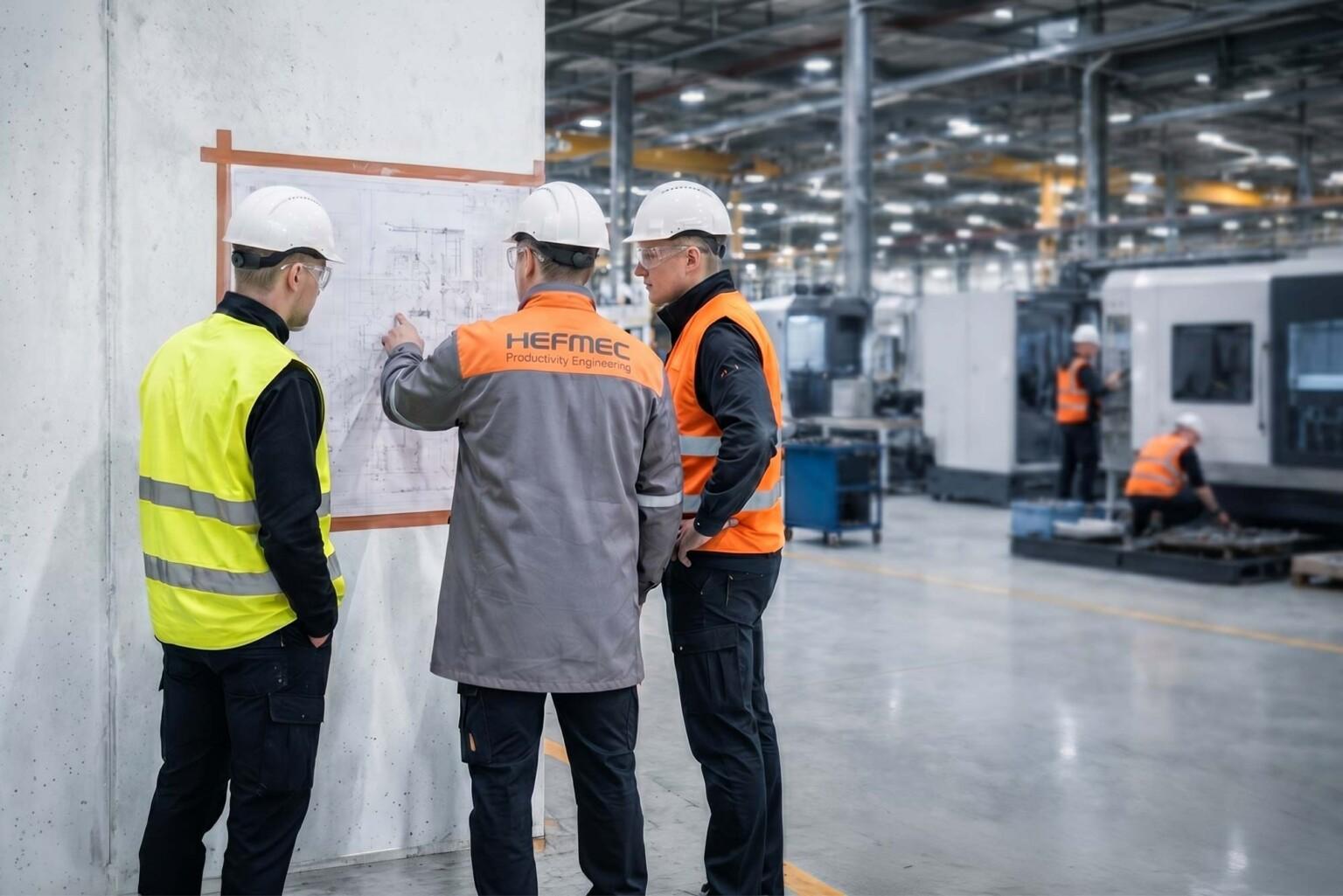
The project manager is responsible for the whole, the project engineer for technical implementation. In a large project, there may be several project engineers, each in their own area, such as process equipment, automation or facilities.
| Role | Responsible for | Typical tasks |
|---|---|---|
| Project manager | Schedule, budget, risks, contracts and reporting to the steering group | Project plan, change management, cost forecast, supplier management, preparing decisions |
| Project engineer | Technical implementation in their own area | Equipment specification, review of supplier designs, interface coordination, supervision of manufacturing and installation, FAT/SAT and documentation |
When a new factory is built, the project engineer’s role is emphasised, because equipment, facilities and technical systems must be completed at the same time. The project engineer is often the first to notice that an equipment connection, foundation or maintenance space does not match the building plans.
How are risks and costs kept under control?
- Timing of decisions: a change is least expensive at the definition stage. Every late change affects supplier designs, procurement and the schedule. That is why changes are handled as recorded change requests, and their impact on cost, schedule and quality is assessed before a decision is made.
- Interfaces: a responsible person is named for every interface between suppliers. Mechanical, electrical and automation connections as well as building provisions are checked before manufacturing, not only during installation.
- Cost forecast: actual and committed costs and an estimate of remaining costs are updated regularly. This way a budget deviation becomes visible while it can still be influenced.
- Technical documentation: requirements, drawings, test reports and operating instructions are kept up to date throughout the project. When documentation is compiled only at the end, commissioning is delayed and maintenance becomes more difficult.
What are the typical pitfalls of industrial projects?
In our experience, projects rarely fail because of one big mistake but because of small decisions that are not made in time. Typical pitfalls are
- user requirements remain vague, and quotations are not comparable
- interfaces between suppliers are left without a responsible person
- the schedule has no time for testing and production ramp-up
- the project owner and decision-makers are unclear, so decisions are delayed
- documentation is compiled only at the end of the project.
When should project management be outsourced?
An external project manager or project engineer is worth bringing in when
- your own organisation is running production and has no free project management capacity
- the project is rare, such as a new factory or a production relocation, and experience has not accumulated in your own organisation
- special expertise is needed, such as FAT/SAT testing, qualification or GxP documentation.
An external project manager brings methods and experience, but decision-making authority remains with the customer. For example, in a major investment project in the automotive industry, our team included project engineers, designers and experts who were responsible for audits and the design, procurement and commissioning of production equipment, among other things. In our pharmaceutical customer’s largest investment in decades, our team grew to around ten experts whose tasks included qualifications, procurement and commissioning of process equipment, FAT/SAT plans and project engineering tasks.
At Valmet Automotive, we coordinated the implementation of welding and assembly lines for a new car model from design to commissioning on a fast schedule, and production started in record time.
Do you have any questions?
We are happy to discuss how we can support your investment project. You can find more information on our project and expert services page, or contact our service manager directly:
Mika Julin, Service Manager, Project and Expert Services, tel. +358 40 708 4567, mika.julin@hefmec.com