We helped a customer solve a strength-related problem, and the result was a patented machine.
What is punching?
Punching is a sheet and tube metalworking method in which a punch is pressed through the material against a die. The punch shears a hole or shape in the workpiece, and the cut-out piece – the slug – drops through the die. Piercing a hole in the wall of a tube is a special case of punching. (More on Wikipedia.)
Why doesn’t the punch survive piercing the tube?
In spring 2020, I had been working at Hefmec for about two years alongside my Master’s studies in engineering. I had already seen many different projects in the automotive, food and heavy engineering industries and in many other sectors. Then, in one customer project, I came across a situation that looked quite harmless at first sight:

The customer was developing a punching machine for piercing tubes from the side – a task known in advance to be difficult. It was a new method with high expectations. In practical tests, however, none of the punches tested lasted in use, and as a result the machine the customer was developing could not be completed.
Hefmec takes on the challenge
We had been doing mechanical design for this highly innovative customer for years. The division of work was clear: the customer has decades of experience in solving problems in its own field, and we have extensive experience in using modern 3D design software. That made us a natural partner for solving this challenge too. Already at the start of the project, everyone had an educated guess about the root cause. As we studied the challenge more closely, it became clear that, in addition to a tricky problem, it could also provide material for a Master’s thesis.
Root cause analysis: the forces acting on the punch
In normal punching, the material is cut perpendicularly, so the forces acting on the tool run along the punch and have little bending effect. The customer tried different punches without significant improvement in the cut quality or the punch life. In piercing a tube from the side, the challenge was the lateral forces acting on the tip of the punch, because the punch does not move perpendicularly to the tube surface. The lateral forces caused heavy bending at the punch tip, so the punch lasted only a few piercing cycles before it broke.
Simulating the problem and searching for the optimal geometry
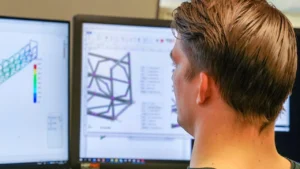
The aim of shaping the punch was to reduce the forces acting on it. We modelled the punch at different stages of the cutting process and studied the shape of the cutting edge in relation to the hole being formed. The goal was to shape the edge so that the slug separates by shearing rather than tearing.
Reaching a solution through practical tests
- The right clearance
We also determined the right clearance between the punch and the die. A smaller clearance gives a better cut quality, while a larger clearance reduces the forces acting on the punch. The right clearance, which gave a sufficient cut quality, was finally found through practical tests. - Lubrication
Lubrication was added to the punch to reduce friction. This reduced the required force even further. - Material
Powder metallurgy steel was chosen as the material of the final punch, as it combines toughness and hardness in the best way. It was combined with a suitable surface treatment that made the punch surface sufficiently wear-resistant.

The result of the project was a durable punch that also produced a good cut quality. The customer was able to apply for a patent for the machine, and I completed my Master’s thesis with good grades!
Do you have similar challenges with punching or other manufacturing methods? Contact our COO Petja Lindström (+358 40 740 4771), and let’s develop the right tools and methods for you together!